Monday, February 15, 2016

4th Grade Business Sale a la Design Thinking

Our fourth grade students have an annual project that directly ties to benchmarks we identified as essential in the areas of math and social studies. This project has come to be known as the annual business sale. This year, we tried to adjust and make this project more "real world" for students by incorporating design thinking. While in prior years, student groups just chose an object to make, market, and sell, this year we approached things differently. Before deciding on an item, we introduced the fourth graders to the concept of "market research" and made this research a big part of the process this time. We had all of the students go out and talk with possible customers about what they would like to see available.

Market research with potential customers
Following the market research, students wrote up a business proposal and presented those proposals using newly acquired technology training. Side note: Again, we must note how important it is to backwards design these projects to ensure the students are skilled-up on essential functions prior to them applying those skills in a more public manner. In order to craft a successful proposal, students learned Keynote as well as learning basic modeling to project costs and revenue streams. Both of these elements were brand new to the project this year. They were highly successful additions!
Creating a business proposal presentation
A student shares their business proposal with peers
The next step was to create print advertisements in their art classes, and then going back to their technology learning to create a green-screen oriented commercial. As part of the research on marketing, students studied about various sales and marketing techniques, and those techniques had to be evident in their materials.
Creating advertisements for the sale

Learning about why some products sell and some don't in library


Creating Prototypes


Students then made prototypes and iterated designs before settling on the final design. This led right into the sale itself. Sales were on par as years past - perhaps just a bit higher than average but still robust. Students sold their items like small stores, including having a "season end" sale time a couple of weeks later on to finish selling all products.  


After the sale, the students then researched where they'd donate their proceeds and they also wrote a narrative persuasive essay about why funds should go to that cause. All in all, the project was very successful, and we had higher involvement of our specials and core classrooms. The student engagement was very, very high. On the other side, the vision for this project was probably less sharp than we would have preferred - it could have been more cohesive because of the meshing of content and product creation and we missed some key opportunities to more seamlessly integrate the many moving parts. This is something we will take into consideration when we approach the business sale next year.


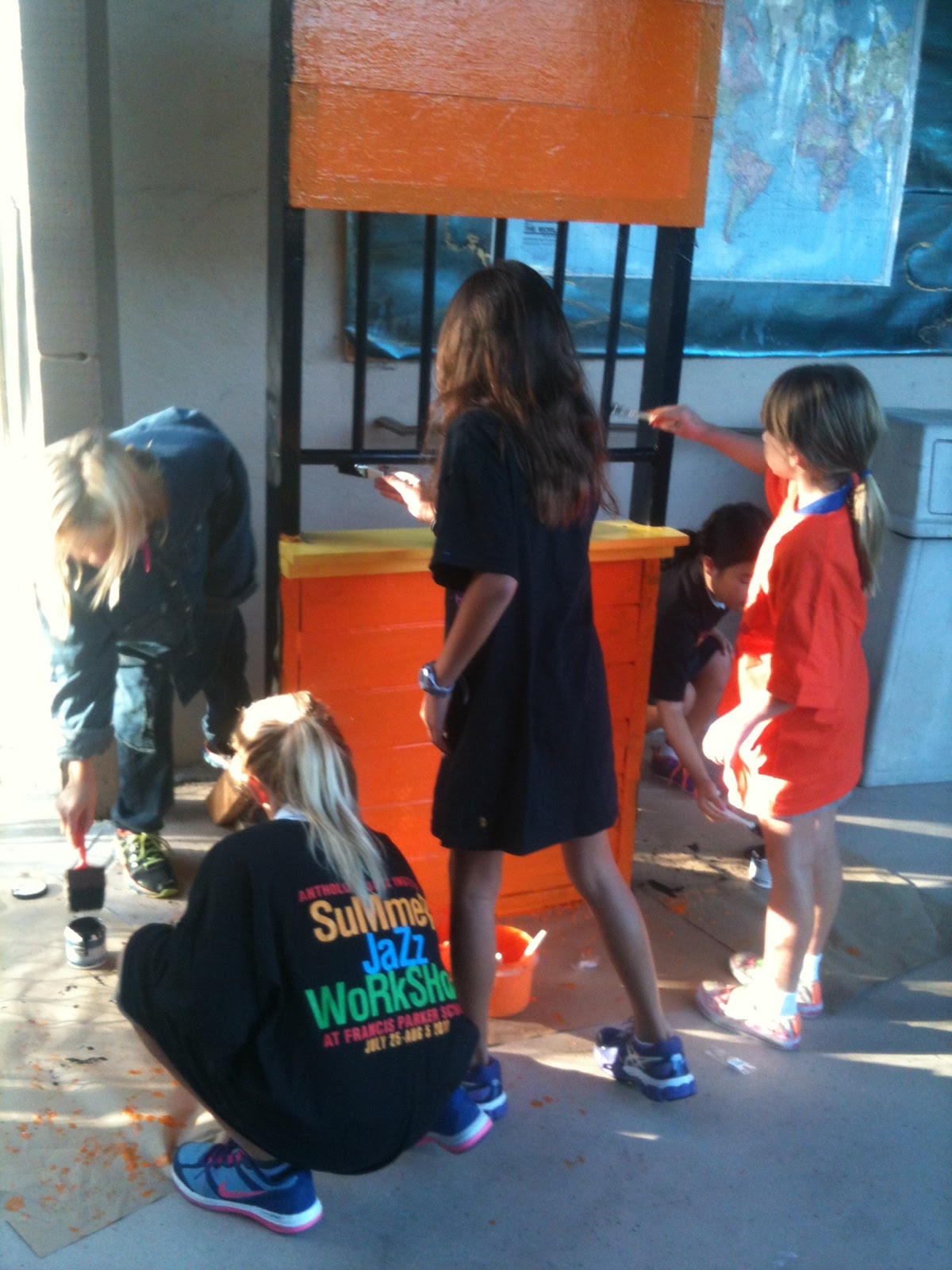
Production day

Wednesday, December 9, 2015

Hour of Code

Excited students try their hands at coding. Every Lower School student participated in the Hour of Code!

On December 9th, the entire Francis Parker School engaged in an "Hour of Code" - a national movement to raise awareness of coding and to garner student interest in coding related activities and educational pursuits. While our Middle and Upper School students tackled projects and introductions to coding, our Lower School students almost felt like it was just another day as they had been actively engaging in coding for the better part of a month. The purpose of the Hour of Code at Parker was to help students who had not previously experienced coding get some hands-on experience, and for those who had experience, they were given a chance to show off their work to their peers. 

All students also got exposure to the idea that coding drives many things in their lives - be it video games, or particular online activities, engineering, or even fashion design. 

All in all, it was a fun day that engaged our students. It was clear that they all enjoyed the coding activities, as well as the opportunity to solve a variety of puzzles that had their origins in coding. 

Tuesday, December 1, 2015

The San Diego Maker Faire: SUCCESS!!! and 5th grade explorers project

When we were presented with the idea of going to the STEAM maker fair in December, there was a mix of hesitation and excitement. Ultimately we wanted to share our experiences with the educational and Design Thinking community to continue to grow and develop as a program. We thought the best way to represent exactly what it is we do here at Francis Parker Lower school was to provide those visiting our booth an opportunity to “walk through” a design thinking project as an active participant. We wanted to show how each step of the Design Thinking process had a well designed project element that was directly associated with our Design Thinking model here at Parker.
    To achieve this we chose the fifth grade boat project, which involves students learning the fundamentals about boat design and buoyancy along with supporting the classroom’s social studies curriculum. In the classroom, students built boats out of cardboard, tinfoil and tape followed by measuring the amount of weight each boat could hold. After the first couple of iterations, students brought those experiences to the design lab where they worked with a partner to create a final boat design. Students brainstormed different designs on paper and discussed the benefits of the different designs before having access to materials. Once the final boat design was decided upon, students worked together to create their boats which were again tested with different amounts of weights but were also put up against a variety of hazards such as wind, rain, and waves. This was done in a 12 by 4 foot pool made out of old garden boxes and a large tarp along with a drill rigged up to a pulley system that pulled each boat across at a standardized speed.
    As boats were being designed, created, and tested, students were also creating Sea Monster paintings in Art, studying buoyancy in science, and continuing to study the age of exploration in the classroom. It is in these interdisciplinary experiences, lasting memories in students are made and the learning experiences become much more meaningful. As you entered our booth at the maker fair, you were immediately presented with the challenge we presented to the kids, along with the opportunity to design and create your own boat using the same materials and even test the boat in our pool of water. There were examples of students art work along with a video of students testing their boats with different weights and different hazards thrown their way. Lastly, as we do everyday in the Design Lab at Parker, we asked participants to reflect upon the experience and record some of those thoughts on a provided poster board. The turnout was great and the feedback provided to us was equally as rewarding. Students, parents, and teachers who visited our booth that day were engaged and excited to walk through the Design Thinking process we use here at Parker everyday. 

Monday, November 16, 2015

Importance of Reflection in Design Thinking Learning


One of the big benefits that we have seen by integrating design thinking into our curriculum is the way in which it breaks down the thinking, creating, reflecting, refining and sharing process. As you know from prior posts, we designed our own Parker Design Thinking process. We spent a large part of our year last year ingraining this with our faculty and students. This year our focus has been to bring this process to life as we work with students to tackle integrated design thinking projects.

One of the major components of this is reflection. Theorists from Piaget to Vygotsky to Bandura have all advocated the benefits of metacognitive strategy use with students of all ages. The more students reflect on their learning and the process of learning, the more they build confidence in their capability to achieve realistic goals in subsequent projects. This is commonly known as the self-regulatory, self-efficacy cycle. When students can self-regulate (e.g., they know how to monitor their progress and adjust goals and deadlines) they become more confident in their ability which leads to increased self-efficacy (e.g., they know they can do it). Additional benefits of being able to capably manage time and articulate needed steps also arise from using structured reflection.

We are using reflection in a variety of ways within the Scripps Design Center and in our design thinking project. Sometimes it is written, sometimes it is full group, sometimes it is individual, sometimes it happens in small groups. Sometimes we orient on a specific skill or problem, while other times we speak to more generalized issues that are presenting themselves. We try very hard to adapt to the situation and where our students are in their work.

This year we are intentionally focusing kids on reflecting on their process and skill development in addition to content learning. We've tackled this in a few ways. One way we have done this is to use our design thinking process to help kids with reflecting. Below you see some great examples of how we formalized the reflection component following the completion of a project. Students articulated their work using the steps.

Each step of the Parker Design Process is articulated vis-a-vis a specific project by students. 

We often use this reflection as a way to evaluate what students got out of the day's lesson as well as to help us determine where we need to go with subsequent sessions - in other words, this has become a powerful formative assessment cycle for both kids and faculty.

A huge HUGE win is that while we (faculty) guided these reflection sessions initially, students are now leading the charge. In the photo below, you see a student up front guiding her peers through a reflection on a lesson in which they had built squishy circuits. We are now seeing classroom teachers tapping this student skill in the general classrooms as well, which is very awesome to see.

A student leads her peers in reflecting on what was accomplished in class, as well as talking about next steps. 

Monday, November 9, 2015

5th Grade Project: Survivor Project

Survivor project: we did this project last year (see earlier blog post near the start of this blog).

Survival project is five years old, and it started as a PBL activity. Empathy is the biggest change in this project and as we have reworked it we have moved more towards getting kids to really live and understand the challenges inherent in early peoples. Kids have appreciation and understanding of early peoples, and that's what we really wanted them to get. Cooperation v conflict piece. Having them do things in authentic ways where learning is real. Tying in common threads all the way through curriculum to the design center. Tie ins to the books they read, etc.

Students build shelters and basic hunting weapons as part of this unit of study. The biggest difference from last year is that we did a two day build on shelters instead of just one day. This way students could plan it out more and also see if their shelters could stand up overnight. Making fire was not a part of the build this time around. We added in making water vessels and spear making/throwing (tool making) this year as it was a better use of time and also more student-friendly (could be tested indoors or outdoors). Materials for structures were more standardized to be more even for all teams.

This time around we had students do open ended research and then use their social studies book to get more specific info about their region. We also had a parent come in this year to talk with students - they are a survivalist, teaches Marines on survival techniques, and it was intense. Kids learned a lot from him and they enjoyed that lesson immensely.

Bottom line? Kids love this project! They made spears and got to throw them at a box. The tool making was the best part of this for the kids. Better appreciation for the fact that it is difficult to make things and live with primitive tools. They see how hard it is to "hunt" so they end up realizing berry picking. Of 60 kids only 4 had successful spear building (spear stuck in the box). The difficulties of making work-able solutions with basic materials was a BIG realization for kids. Great learning!

Reflection:
Next year - start bringing in materials at the start of school so that we have enough materials for all teams. We need to make a stronger curriculum tie in: how does geography and climate affect culture and housing for people. They are learning about different regions, etc.

Monday, October 19, 2015

4th Grade: Skill Building Mini Lessons


As the school year began, we wanted to not only directly teach specific elements of the Design Thinking process but also intentionally develop associated skills that would allow students to more effectively engage with the our Design Thinking Model here at Parker. Some of those associated skills include: Collaboration and Effective Communication skills along with developing empathy as it is the primary driver of Design Thinking. We intentionally develop these skills because it is those skills that will allow students to more effectively use the design thinking process to solve various problems and challenges presented to them in the variety of disciplines throughout their school year.

    The use of mini lessons to teach these skills and concepts can be viewed as building blocks, strengthening the students abilities to apply this knowledge in a variety of ways. One of our first mini lessons involved students practicing collaborative and effective communication skills by working in small groups to solve a problem presented to them with a variety of constraints and boundaries. Students were asked to build bridges from one of our classroom workbenches to another workbench. During this one-hour work period, students were given time limits on brainstorming periods, designing periods, and building periods. To highlight the importance of having a well designed plan and staying focused even in difficult or stressful situations we periodically presented distractions such as playing music or implementing a “no-talking period” which allowed for some very insightful reflections at the conclusion of the design challenge.

We used another mini lesson used to directly teach empathy, which involved students again working in groups, using their newly acquired collaboration and communication skills to build products based on the needs of other students. Each group was first asked to write a short description of a product without specifically naming the product that would help meet a need of the group. The groups were then given 10-15 minutes at each table where they read over other groups descriptions and built a product based on the needs of the other groups. Each group placed their product in a box and moved onto the next groups description. By the end of the work period, each group had three products in their box, made by other groups based on the short description they earlier wrote. As each group opened their box, they noticed that some of products were similar and some were very different. This allowed for students to discuss why they made their product in that specific way based on descriptions provided while also highlighting that people view things in different ways and that to show empathy you must be able to view things from the perspective of others. Each group then selected the product that best met their need and the winning group was able to explain how they came to that design. The biggest take away for the students based on their reflections was that the most successful groups in this mini lesson were those that were able to think like the other groups, viewing the need from anothers perspective and showing empathy.

Monday, October 5, 2015

Design Thinking? I've got a book for that!


When you ask a children's librarian to contribute to a blog, chances are you are going to get a story.  Well, today is no exception.  You are going to get several, in fact.  In the library, there are very few opportunities for students to engage in a complete Design Thinking activity, so we use literature to teach mini lessons highlighting the various elements of the Design Thinking process.  These stories show great examples of the "design, create, test" loop, offer opportunities to teach brainstorming techniques,  show the importance of empathy in the design process, and highlight the importance of collaboration and persistence.  Most importantly, however, they are all excellent and engaging read aloud stories that exemplify the Design Thinking process in a kid friendly way.

Here are some of my favorites...


 Queen Victoria's Bathing Machine by Gloria Wheelan

Poor Queen Victoria! She loves to swim, but can't quite figure out how to get to the water without her devoted subjects glimpsing her swimming suit. (Because, of course, such a sight would compromise her regal dignity.) Fortunately for the water-loving monarch, it's Prince Albert to the rescue with an invention fit for a queen! 
What Floats in a Moat?  by Lynne Berry

Archie the Goat has a delivery to make. He has several barrels of buttermilk that the queen needs, but in order to get them to her, he needs to cross the moat.  Testing several different theories to find out what will float and what will sink, Archie and his friend Skinny the Hen don't succeed at first, but they do try, try, try again (and again). And with reason and persistence, they'll get that buttermilk where it needs to be!
Spic-and-Span!  Lillian Gilbreth's Wonder Kitchen by Monica Kulling 

Born into a life of privilege in 1878, Lillian Moller Gilbreth put her pampered life aside for one of adventure and challenge. She and her husband, Frank, became efficiency experts by studying the actions of factory workers. They ran their home efficiently, too. When Frank suddenly died, Lillian was left to her own devices to raise their eleven children. Eventually, she was hired by the Brooklyn Borough Gas Company to improve kitchen design, which was only the beginning.

Pop!  The invention of Bubble Gum by Meghan McCarthy 

Gum. It's been around for centuries—from the ancient Greeks to the American Indians, everyone's chewed it. But the best kind of gum—bubble gum!—wasn't invented until 1928, when an enterprising young accountant at Fleer Gum and Candy used his spare time to experiment with different recipes.

The Most Magnificent Thing by Ashley Spires 

A little girl has a wonderful idea. With the help of her canine assistant, she is going to make the most magnificent thing! She knows just how it will look. She knows just how it will work. But making the most magnificent thing turns out to be harder than she thinks. 


Twenty-Two Cents : Muhammad Yunus and the Village Bank by Paula Yoo

A biography of Nobel Peace Prize winner Muhammad Yunus, who from a young age was determined to make difference in the world and eventually revolutionized global antipoverty efforts by developing the innovative economic concept of micro-lending.
What Do You Do With An Idea? by Kobi Yamada

This is the story of one brilliant idea and the child who helps bring it into the world

 Rosie Revere, Engineer by Andrea Beaty

Rosie may seem quiet during the day, but at night she's a brilliant inventor of gizmos and gadgets who dreams of becoming a great engineer. When her great-great-aunt Rose (Rosie the Riveter) comes for a visit and mentions her one unfinished goal--to fly--Rosie sets to work building a contraption to make her aunt's dream come true. But when her contraption doesn't fly but rather hovers for a moment and then crashes, Rosie deems the invention a failure. On the contrary, Aunt Rose insists that Rosie's contraption was a raging success: you can only truly fail, she explains, if you quit. 

Monday, September 14, 2015

3rd Grade: Blending Skill with Innovation

Design Thinking vs. Basic Woodworking skills...which should we do?  Both!  

While directly teaching the Design Thinking process is one of our main goals, it is equally important to develop the skills needed to interact and engage with our Design Lab tools in a safe and appropriate way. Francis Parker 3rd graders started off the year by with the skill building challenge of creating an iPad holder.   Students learned to cut notches in small hard-board pieces using a provided template and a coping saw to create a desktop iPad holder for use in the classroom (making this project very popular with the classroom teachers!).
 
After the students have used their iPad holder for a couple of months, we will circle back and have students take another look at their design, how it is used, and how it could be improved to better meet their needs.  To directly develop empathetic skills in these students, we will ask them to interview another student, attempting to better understand the others perspective and individual needs.  The students will then take that information and continue along the Design Thinking process, brainstorming improvements to the holder, and designing and creating a improved iPad holder that will better meet the needs of their partner.  
   
 We are using this seemingly small, introductory  project to not only develop fundamental skills needed to effectively and safely engage with the design center and its many tools, but also to directly teach the Design Thinking process and help the students develop empathy and effective communication. Win-Win!

We can't wait to see what they come up with!

Monday, August 17, 2015

Transformation: The Scripps Design Center

At the end of year one, we learned a lot of things from our dabbling in Design Thinking, but a primary concern that surfaced was related to space. A regular problem had arisen: kids would be elbow deep in an exciting project only to discover that they would need a particular material only found in another location on campus. To get this material, they had to head all the way to the other end of campus to get it, and would sometimes go on extended tours in this process. We realized that it was going to be critical to have teaching spaces that were design oriented needed be located in a common area. This area could not be too far removed from the general classrooms to save on travel time as well as to afford greater integration of projects with learning. 

We had a space that was set aside for large meetings and other school functions, but typically was not heavily used during the school day. After a lot of discussion and meetings, the decision was made to relocate our wood shop and art room to another part of campus, and to house them next to one another as well as positioning them next to our science classrooms and library. This would afford us the ability to physically de-silo the specials classes in which design thinking projects would take place. It also helped with students being able to easily access materials and teachers when working on projects. 

Happily, new flooring and electric were only real construction elements that we had to consider. This resulted in minimal costs that we were able to take from annual capital improvement. This was a deliberate consideration - we weren't sure what the kids would need, so we put things in place that we knew we would use, and then build from there based on the projects that came to life during the year. We took what we had from other parts of the school to encompass both functions (technology and woodworking/fabrication shop) that we needed in the space.

We had a small handful of teachers willingly relocate their classroom space to accomplish this - and the results have been outstanding... 

This relocation of spaces has completely transformed the way we teach. It also honors what we promised to do from the outset, which is to build a lab that would meet the emergent needs that came about as a result of dabbling in Design Thinking in year one. This process held us true to our commitment to let philosophy and student outcomes drive physical space decisions and considerations. 

Our new Scripps Design Center, ready for action!
The fall semester project board shows a full docket of integrated projects in almost every grade level.
This new space has breathed new life into our design thinking projects this year, and because it is in a better adjacency to regular classrooms, it is also allowing us to bridge the gap between classroom instruction and projects in a way that proved nearly impossible last year. It has facilitated a great deal of collaboration for the design team as well as for the design team and classroom teachers. In fact, it's not unusual to see the classroom teacher dropping in to check on student progress to see how the work in the Scripps Design Center underpins and supports what they are teaching their kids in the academic classroom.

Today, we free flow through the spaces in and around the Scripps Design Center - both students and faculty. This free movement has allowed kids to expand their thinking and incorporate both engineering design and artistic considerations into whole, integrated projects. We are also seeing greater free flowing of our faculty in terms of on-the-fly collaboration and just-in-time adjustments to instructional pacing. This all serves to benefit our students by providing improved pathways to achieve what they set out to create.

Thursday, June 18, 2015

Lower School Design Thinking Year 1


"Implementation is invitational, but learning about Design Thinking is mandatory."  This was the message as we embarked on our Design Thinking journey.  Accepting that invitation, we here at the Lower School immediately began looking for ways to implement Design Thinking.  Our initial attempts saw us doing this in three different ways.  First, the group of teachers who would become the "Design Team" started by working with small groups of students.  We lead the Student Council through a Design Thinking exercise to discover and implement a better way to track tickets at the Halloween Carnival.

Introducing the Design Thinking process
Brainstorming ways to track the tickets
Bringing their vision to life
  
Our fifth grade students then noticed that given the upcoming holiday concert season, visitors to our campus might need more information that you would find on a traditional campus map.  So we led them through the Design Thinking process to design maps featuring the best places to park, accessible ramps, and even the coldest drinking fountains!
Students interviewed the office staff and our safety patrol officer to create this map of the best places to park.
As we were doing this the team noticed that brainstorming, collaboration, and all of the other elements of design thinking weren’t innate skills for many kids and needed to be taught.  To that end the second thing we did was to begin using Design Thinking challenges to teach/model these individual skills. 
For example, in the library,  we did a mini lesson on brainstorming.  We read a story about Queen Victoria, who loved to swim but was unable to get to the beach while preserving her modesty.  
 Right before the innovation was revealed we stopped, and brainstormed our own ideas following the rules of brainstorming…


1.  Listen respectfully/let all voices be heard. 
2.  Defer judgment/there are no bad ideas.
3.  Build on the ideas of others/ use “yes, and…” statements.  


Students had some creative solutions to Queen Victoria's problem

Here are a few other examples of ways we taught the individual steps...
This engineering challenge was the perfect opportunity to teach collaborative skills

Try, try again.  Students had to come up with several iterations of a catapult.

When we think of Design Thinking, we tend to think of product innovation, but at it's core Design Thinking is a repeatable process that can be applied to any problem or challenge.  So, the third thing we did was to go into classrooms and work with teachers to show them how to "tweak" their existing lessons to reflect a more Design Thinking approach, in other words,  show them that Design Thinking is not something that you do...it is how you do it.   

Taking a lesson and making it better.  Instead of taking a test on the Social Studies chapter on transportation, students brainstorm innovations on modern transportation and then create prototypes of their inventions.
 

As we reflected on year 1, we were surprised by many things...the exponential increase in the student's engagement, how much of this we were already doing without realizing it, and just how hard it is for us as teachers to embrace ambiguity.  Our biggest realization, however, was that the two biggest obstacles to teaching in a true interdisciplinary way were time and space-specifically our class schedules and proximity of our classrooms.  

It seems we have a new Design Thinking challenge on our hands...